

The Composer in the Park: Antonín Dvořák and the Sound of Stuyvesant Square

Antonín Dvořák Theatre, Ostrava, Czech Republic (Photo credit: Josep Renalias Lohen11/Wikimedia Commons)
By Reynard Loki, SPNA
On a quiet morning in Stuyvesant Square Park, it’s easy to miss him.
Set slightly apart from the flow of foot traffic, surrounded by trees and the low murmur of the neighborhood, stands a bronze figure on a green granite pedestal. He is not a general, not a politician, not a New York notable in the usual sense. He is a composer—Antonín Dvořák—and for a brief but extraordinary period in the 1890s, he lived just across the street.
Most passersby glance at the statue and move on. But if you stop for a moment, the story it marks opens outward—from this park, to a vanished house on East 17th Street, to a pivotal chapter in American cultural history. Because here, in this neighborhood, Dvořák helped shape what American music could become.
A World-Class Composer Arrives in New York
By the time Dvořák arrived in New York in 1892, he was already one of Europe’s most celebrated composers. Born in 1841 in the small village of Nelahozeves, in what is now the Czech Republic, he rose from modest beginnings—his father ran an inn—to international acclaim. His music drew deeply from Czech and Slavic folk traditions, blending them with the formal structures of classical composition.
That combination—discipline and folk influence—defined his work. It also defined what he would bring to America. Dvořák came to New York to serve as director of the National Conservatory of Music, a bold institution that aimed to cultivate a distinctly American school of composition. He settled at 327 East 17th Street, just steps from what is now Stuyvesant Square Park. For three years, from 1892 to 1895, this quiet block became the center of his life and work. It is difficult to imagine today: one of the most famous composers in the world living in a modest house in the East Village, walking past this park, listening, observing, and thinking about a question that still resonates—What should American music sound like?
Listening to America
Dvořák’s answer was unexpected—and transformative. Rather than importing European traditions wholesale, he believed that American music should emerge from the cultural expressions already present in the country. In particular, he was deeply moved by African-American spirituals and by what he understood of Native American music.
At the Conservatory, he encouraged his students to take these traditions seriously—not as curiosities, but as foundational sources for a national style. Among his students was Harry T. Burleigh, who introduced Dvořák to spirituals that would leave a lasting impression.
Dvořák did not simply borrow these influences—he listened to them, studied them, and advocated for their recognition. He argued publicly that the future of American classical music lay in these traditions, a perspective that was both forward-looking and, for its time, unusually respectful of cultural sources often marginalized in mainstream institutions. This idea—that a national sound should grow from the lived experiences of its people—would echo far beyond his time in New York.

The title page of the autographed score of Dvořák's ninth symphony (1893)
The “New World” Symphony
It was during his years in this neighborhood that Dvořák composed one of the most famous pieces of music ever written: Symphony No. 9 in E minor, commonly known as the “New World Symphony.” Premiered in 1893, the symphony captured something both expansive and intimate—a sense of discovery, of longing, of possibility. While it does not quote specific spirituals or Indigenous melodies directly, it reflects their spirit, their tonal patterns, and their emotional depth.
The second movement, with its haunting English horn theme, is among the most recognizable passages in classical music. It evokes distance and memory, something both rooted and searching—perhaps an echo of the composer’s own experience as a visitor trying to understand a new cultural landscape. What makes the “New World Symphony” remarkable is not just its beauty, but its context. It was conceived here, in a neighborhood not known for grand concert halls, but for everyday life—tenements, schools, churches, and parks like this one. Standing in Stuyvesant Square today, it is worth considering: one of the defining works of American music began just across the street.

1882 image of Antonín Dvořák
A Teacher’s Legacy
Dvořák’s impact in New York extended beyond his own compositions. As director of the Conservatory, he helped shape a generation of musicians who would carry his ideas forward. His students and their students would go on to influence some of the most important figures in American music, including George Gershwin, Aaron Copland, and Duke Ellington.
Through this lineage, Dvořák’s belief in a distinctly American sound—rooted in diverse cultural traditions—became part of the fabric of 20th-century music. From jazz to film scores to modern orchestral works, the influence is still felt. And it traces back, in part, to this neighborhood.
The House That Disappeared
For nearly a century after Dvořák returned to Europe in 1895, his connection to East 17th Street remained physically intact. The house where he lived and worked still stood. But in 1991, it was demolished. Efforts to preserve it as a landmark ultimately failed, and with its loss, the neighborhood came close to losing a tangible link to this chapter of its history. For a time, the site where Dvořák composed the New World Symphony was marked only by absence. What followed, however, was a community response.
In the years after the demolition, the Dvořák American Heritage Association, in collaboration with the New York Philharmonic and the Stuyvesant Park Neighborhood Association, undertook a project to commemorate the composer’s presence in the area. They located a bronze sculpture created decades earlier and worked to restore and install it in the park, directly across from where his home once stood. In 1997, the statue was unveiled, symbolically returning Dvořák to the neighborhood.
The Sculpture and Its Journey
The statue itself has its own story. It was created by Ivan Meštrović, one of the most prominent sculptors of the 20th century and a former student of Auguste Rodin. Cast around 1960, it is believed to be among his final works. For years, however, the sculpture was not displayed publicly. It was gifted to the New York Philharmonic in 1963 but spent decades in relative obscurity, stored on a rooftop terrace at Lincoln Center, where it suffered environmental damage.
When the effort to honor Dvořák in Stuyvesant Square began, the statue was restored—cleaned, repatinated, and mounted on a newly designed base of Brazilian green granite. The architect Jan Hird Pokorny designed the pedestal, grounding the sculpture in both material and meaning. Today, the figure stands at just under eight feet tall, a quiet but dignified presence in the park. It does not dominate the space—it invites discovery.
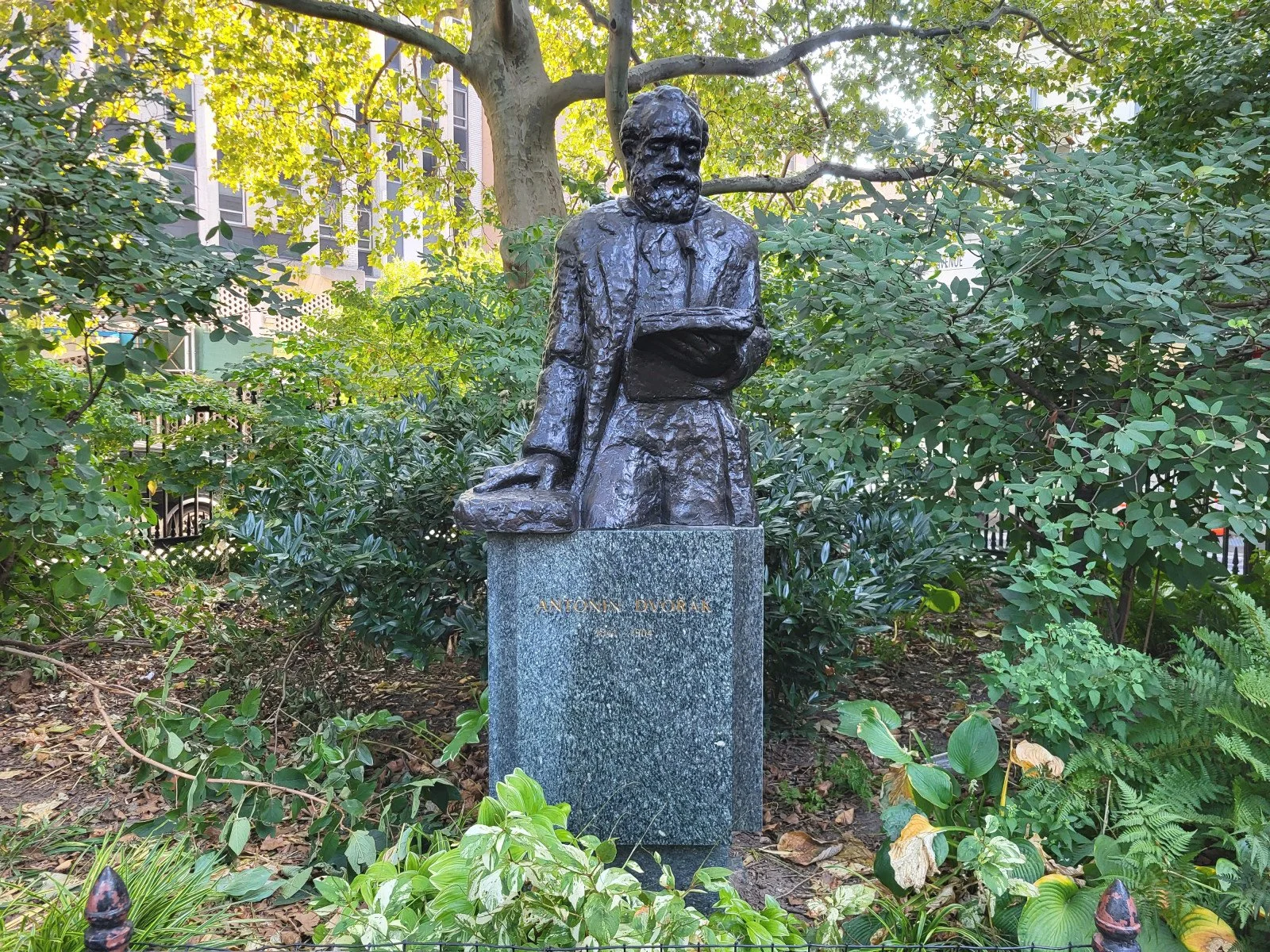
Antonín Dvořák, by Ivan Mestrovic, dedicated on September 13, 1997, northeast corner, Stuyvesant Square Park
A Dedication in the Park
The unveiling of the statue on September 13, 1997, was a moment of recognition—not only for Dvořák, but for the neighborhood itself. Several hundred people attended, including dignitaries from Prague, such as Mayor Jan Koukal. The ceremony was followed by a concert of Dvořák’s music at nearby St. George’s Church, reconnecting the park with the sounds once imagined here. It was, in a sense, a restoration—not of a building, but of memory.
Listening Today
More than a century after Dvořák walked these streets, the neighborhood has changed in countless ways. Buildings have risen and fallen, institutions have come and gone, and the rhythms of the city have accelerated. And yet, in Stuyvesant Square Park, a continuity remains. The statue of Dvořák is not only a marker of the past—it is an invitation. It asks us to consider how place shapes culture, how listening can lead to creation, and how a neighborhood can become part of a much larger story.
For those who want to take that invitation a step further, one simple act can bring the story to life: listening. A walk through the park with the New World Symphony in your ears transforms the space. The rustle of leaves, the distant traffic, the movement of people—all seem to align, briefly, with the music. The park becomes not just a setting, but a participant in the experience.
A Neighborhood Legacy
It is easy to think of great cultural moments as happening elsewhere—in concert halls, capitals, or distant historical scenes. But sometimes, they happen quietly, in places that look much like this one. A composer arrives. He listens. He writes. He leaves. The house is gone. The city moves on.
And then, years later, a community decides that the story matters. That it should be remembered, not in abstraction, but in place. Thanks to that effort—including the work of the Stuyvesant Park Neighborhood Association—Antonín Dvořák's presence endures in Stuyvesant Square Park. Not loudly, not insistently, but steadily.
The next time you pass through, you might pause for a moment. Look at the statue. Think about the music. And consider the possibility that, in this quiet corner of the neighborhood, something of lasting significance once took shape—and, in a way, still resonates today.
Dvorak in Stuyvesant Square: A One-Hour Listening Walk
Experience the music of Antonín Dvořák as you walk through Stuyvesant Square Park. This one-hour playlist features works he composed during or around his time in New York, including selections from the New World Symphony and the “American” Quartet—music shaped by the sounds and spirit of this neighborhood.
[Listen to Dvořák in Stuyvesant Square: A One-Hour Listening Walk]
One-Hour Tracklist (~60 minutes)
Symphony No. 9 “From the New World” – II. Largo
New York Philharmonic / Alan Gilbert — 12:42String Quartet No. 12 in F major, Op. 96 “American” – I. Allegro ma non troppo
Hagen Quartett — 9:28String Quartet No. 12 “American” – II. Lento
American String Quartet & Quintet — 7:07String Quartet No. 12 “American” – III. Molto vivace
Emerson String Quartet — 3:39String Quartet No. 12 “American” – IV. Finale: Vivace ma non troppo
Pacifica Quartet — 5:42Symphony No. 9 “From the New World” – IV. Allegro con fuoco
Wiener Philharmoniker / Herbert von Karajan — 11:25Humoresque No. 7 in G-flat major, Op. 101
The City of Prague Philharmonic / Richard Hein —2:52Silent Woods (Klid), Op. 68 No. 5
Boston Symphony Orchestra / Yo-Yo Ma — 6:19
Do you have a favorite Dvořák piece? Let us know at hello@spnanyc.org—we may add it to the playlist.