

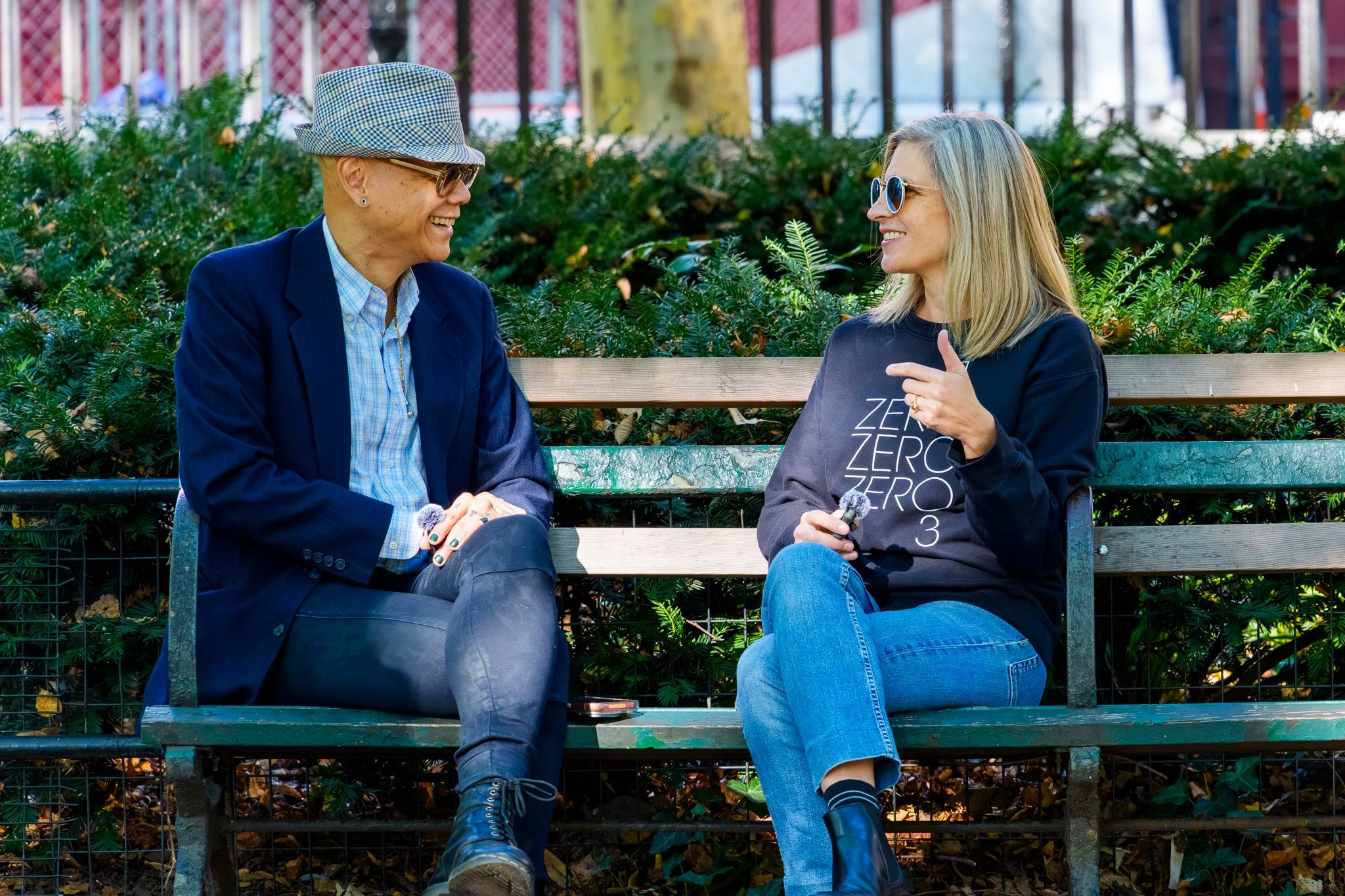
Christine Collister, publisher and editor of Irving, talks with SPNA board member Reynard Loki in Stuyvesant Square Park. Photograph by John Eng.
The publisher and editor on finding a sense of home through a neighborhood magazine—and inviting readers to help make it.
Interview by Reynard Loki | Photographs by John Eng
A neighborhood publication spotted on a walk to the Whitney gave Christine Collister an idea: why not make something similar for Gramercy? A graphic designer with more than 20 years of experience and a BFA from Rhode Island School of Design, she also brought skills in photography, writing, and editing. Irving became a place to bring them together—and a way to connect with her new neighborhood. We met in Stuyvesant Square Park to talk about the magazine’s beginnings, the demands of making it, and the pleasure of hearing from readers who want to contribute.
This interview has been edited and condensed for clarity.
What brought you to the neighborhood, and when did it begin to feel like home?
An incident in our old East Village apartment prompted us to move. We looked at several neighborhoods throughout Manhattan and Brooklyn. A particular apartment in Gramercy stood out. We also thought Gramercy would be the kind of neighborhood change we were looking for.
The apartment itself felt like home very quickly. As far as the neighborhood, I would say it was the combination of learning about its literary and art history and the warm reception the magazine received. Those two things combined were like, oh, and now the neighborhood feels like home too.
How did Irving begin?
In summer 2024, we were walking through the Meatpacking District, going to the Whitney, and their BID had a table set up with a little newsprint publication. I flipped through it. There were local restaurants, local events, and seasonal tidbits. I thought, that’s so fun. Maybe something like that could work in Gramercy.
Through my education and career, I’d picked up basically every skill involved in publishing a magazine: graphic design, photography, writing, editing, and getting it printed. I’d done all of it.
I have a design business, Highly Refined, and I thought this was a tangible way to demonstrate how all these things can work together to make something meaningful and special. I also thought putting something beautiful out there might help me get over the traumatic experience I’d been carrying with me.
Did working on the magazine help?
Initially, it really got me over that hump, better than anything I’d tried. It felt so positive compared to what I was carrying with me.
More recently, I’ve felt anxious about it at times. No one’s pressuring me, but I put pressure on myself to keep the standard high. I always ask, can it be better? Is there more I can be doing? The therapeutic aspect gets a little more muted when I start thinking about those things.
How do you know when to keep pushing and when to let something go?
It’s easier when I think no one but me will notice a detail. If it really comes down to that, it’s crazy to keep focusing on something so minor.
The cover photo, on the other hand, is a huge visual component. It’s the main thing that might make someone pick up the magazine or not. If the photos I’ve taken aren’t there yet, that’s where I put pressure on myself to make sure it’s exactly what I want.
The cover matters so much in print. Was Irving always going to be a print magazine?
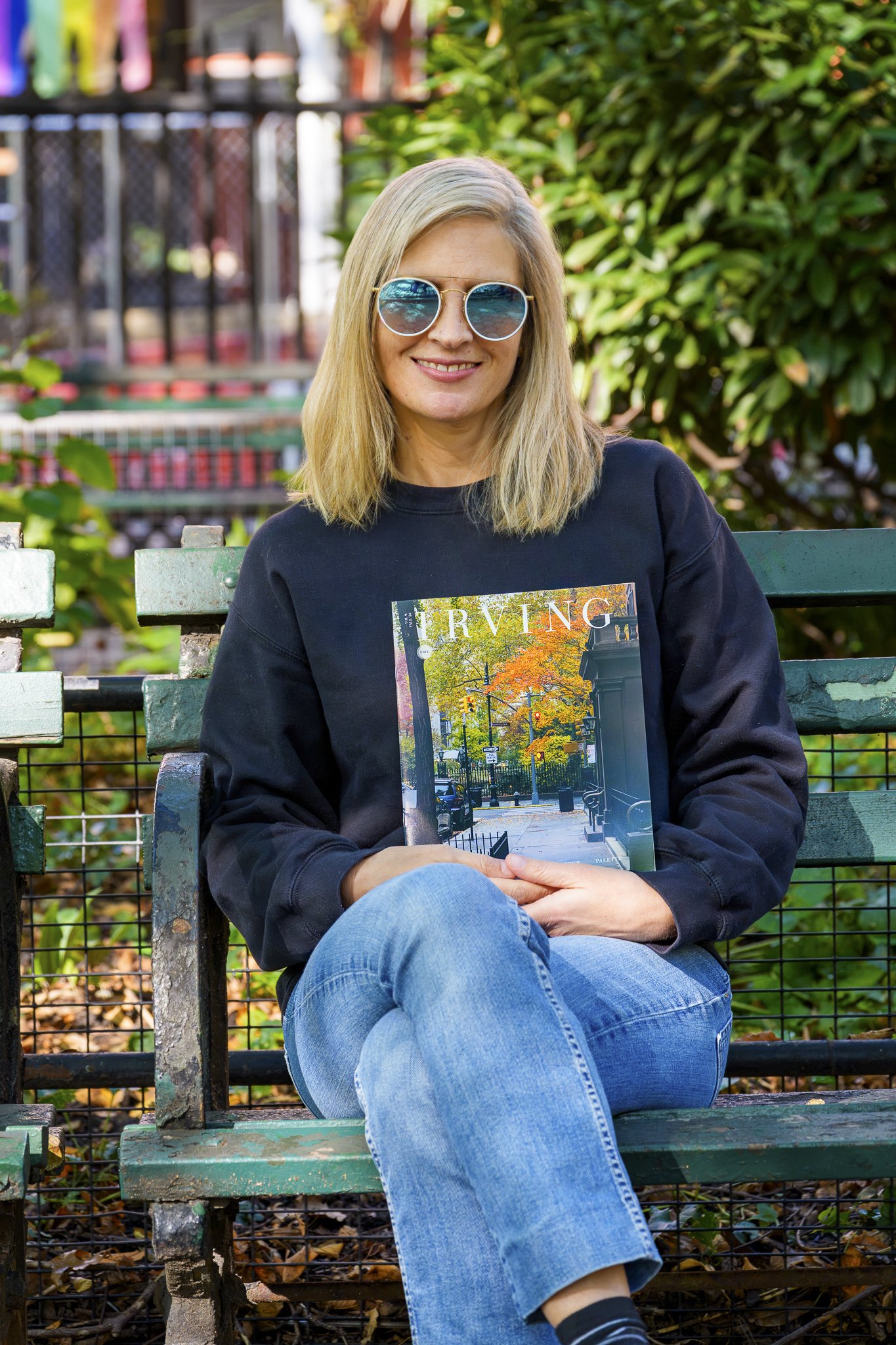
Christine Collister with a copy of Irving in Stuyvesant Square Park. Photograph by John Eng.
It was always my intention. I was trained as a print designer, and growing up, I loved magazines—the way graphic design, writing, and editing come together to make one unified piece.
I also feel that people are realizing the limitations of digital connections. They can be superficial, don’t always make you feel great, and aren’t necessarily local. You can have all these connections on social media and still feel lonely where you live.
Having something tangible about real people who live in your neighborhood, something you can pick up at your local coffee shop or a store you like—that’s a very different feeling of community.
Walk me through how a story becomes a finished feature.
The feature about Paul & Jimmy’s in the Fall issue is a good example. A local designer and photographer, Michael Gerbino, had contributed an essay and photographs about his decades in Gramercy. He mentioned the restaurant, and they contacted me afterward to say they had a story I might want to hear.
I didn’t know they had originally been on Irving Place. I arranged to meet the owners and executive chef and prepared questions. I needed more than the facts that a business was nearby, had new owners, and used to be on Irving. I needed a story.
Even after the meeting, I wasn’t sure of the angle. I mulled it over for weeks before finding a title and subtitle that could frame it. Then I went back, took photographs, and put together a rough layout. Once that was in place, I wrote the article and sent it to them to check for anything I’d gotten wrong.
What else have you uncovered about the neighborhood that surprised you?
Lady Mendl’s Tea Salon on Irving Place. It seemed like a mysterious place to me, in this little walk-up without much of a sign.
When I announced the magazine to a few businesses, they were among those who replied. They invited me to stop by and told me about Elsie de Wolfe, the interior designer after whom the salon is named.
She lived openly with her longtime female partner, Elisabeth Marbury, on Irving Place. She later became Lady Mendl through her marriage to British diplomat Sir Charles Mendl. Her approach to interiors helped move people away from dark Victorian rooms toward something brighter, airier, and more colorful.
I was blown away. That’s what I’m trying to uncover without making Irving a history magazine: stories that are relevant today, that might inspire someone or make them see the neighborhood differently.
Who else is helping you tell those stories?
I have regular contributors now. My friend Venessa Lee, who’s an acupuncturist with a business in the neighborhood, contributed from the beginning. It was important right away to have another voice in there.
Annie Grossman came across the magazine at Irving Farm, the first place that carried it. After a few issues, she reached out and said she’d been following it and wanted to be involved. She’s a journalist and dog trainer who has lived in the neighborhood since birth. We met and came up with the concept that she would interview a dog owner from around the neighborhood. She had a vision for the tone and whom she wanted to feature, and she took it from there. Now she writes about books too.
And starting with the upcoming holiday issue, Matt Jill of the Instagram account Gramercy Local—which primarily focuses on restaurant and retail openings and closings in the neighborhood—will contribute a page.
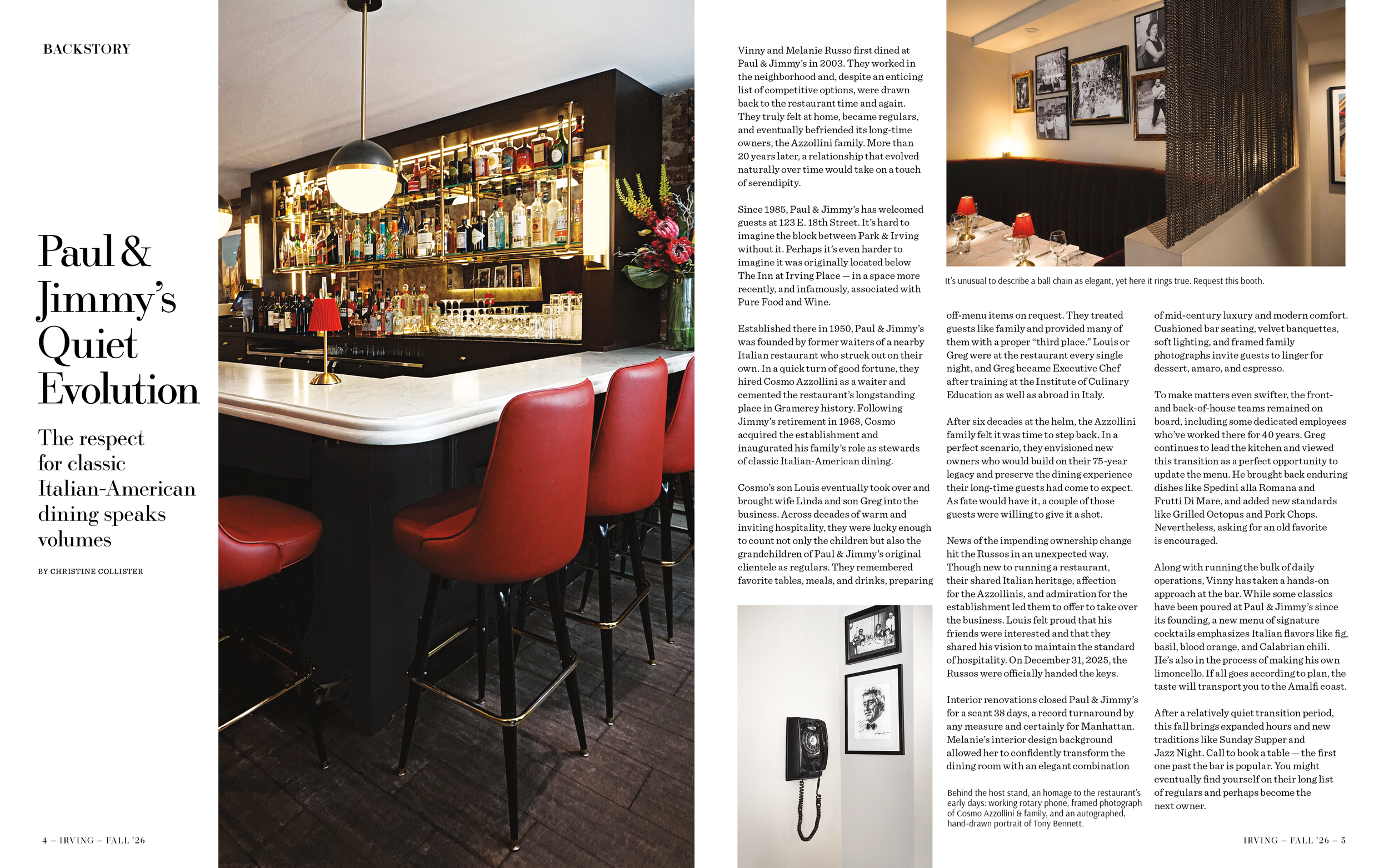
“Paul & Jimmy’s Quiet Evolution,” a feature by Christine Collister in Irving’s Fall 2026 issue, pages 4–5. Courtesy of Irving magazine.
Annie started as a reader who wanted to get involved. What’s it like when someone reaches out that way?
When a reader contacts me to say they’d like to contribute, it’s very rewarding. This is part of what I always thought could happen with a hyperlocal publication: someone reads it and wants to participate.
Just last week, a reader named Sara wrote to say she enjoys home decor. Friends and family have asked her to decorate their homes for holidays or events. Could she contribute a holiday decor article? I was like, obviously, yes.
Has making Irving changed your relationship with your neighbors?
Yes. Now I can walk around, wave to people, and stop to chat. I never did that in any other neighborhood I lived in across 19 years in NYC.
You also volunteer to clean up Irving Place. How did that begin?
Some neighbors in my building complained to me about the trash. I’d noticed it too and wanted to be part of the solution. I researched block cleanups and found the Sanitation Foundation’s Adopt-a-Spot program. I signed up to adopt Irving Place between 17th and 19th Streets and made a donation that came with a cleanup kit.
Now I go out once or twice a week and fill a bag, pretty much until I can’t carry it, then take it to a trash can.
What’s your relationship with Stuyvesant Square Park?
Whenever I’m walking between Gramercy or Flatiron and somewhere east and downtown, I purposely go through these parks because they’re so pretty. Why walk along 14th Street when these are right here? I love it when the fountains are on and the flowers are blooming.
I also learned in the park that pigeons will actually sit right on you—I had no idea they’d do that until one landed on me—and was blown away by how curious and smart they seem. It’s restorative to interact with New York City’s wildlife, even the pigeons and squirrels.
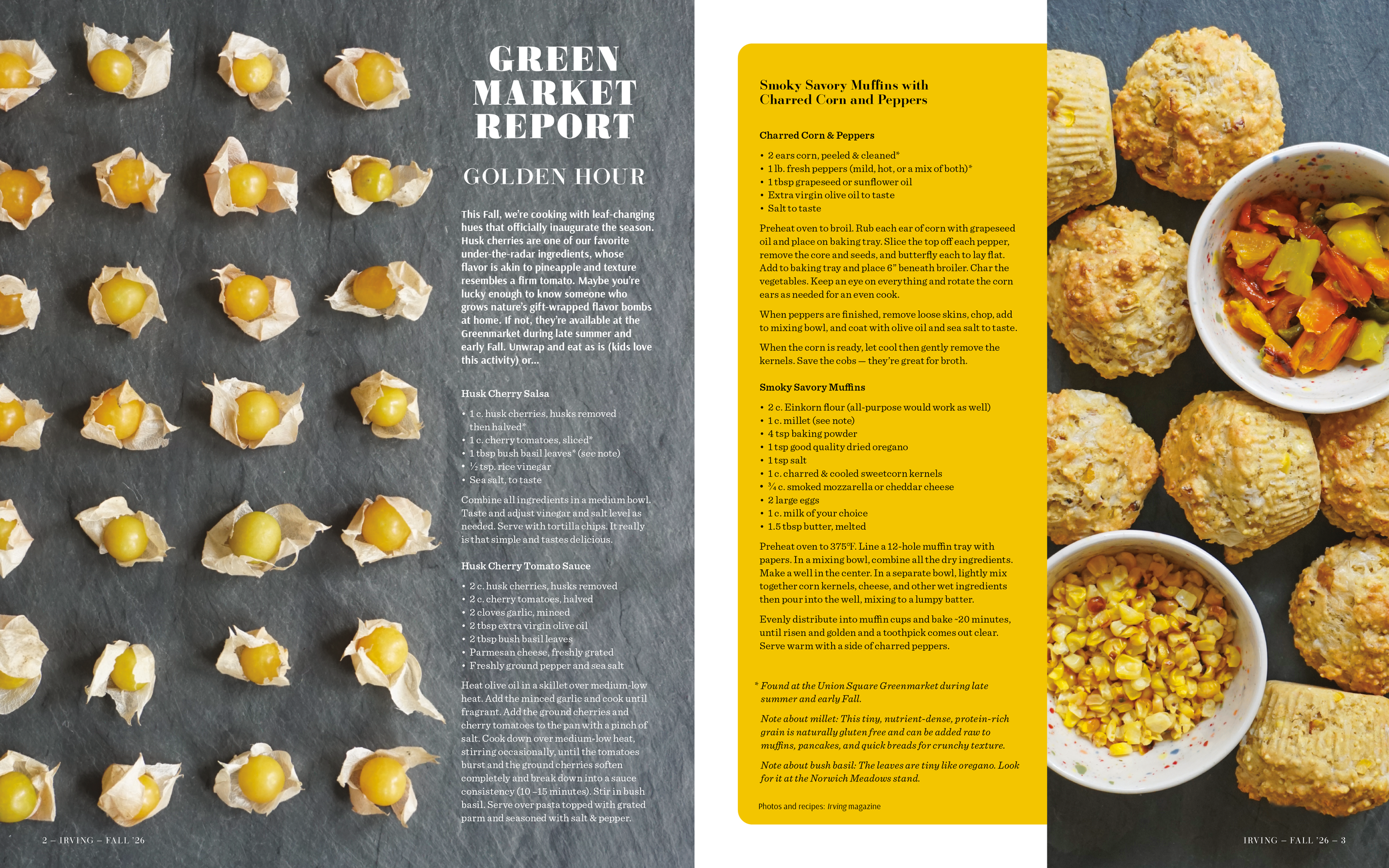
“Green Market Report: Golden Hour,” seasonal recipes from Irving’s Fall 2026 issue, pages 2–3. Photographs and recipes courtesy of Irving magazine.
Is there a particular reader response that has stayed with you?
The photographer Duane Michals loved the cover photograph of the first issue. A mutual connection had brought him a copy, and he wanted to meet me.
I’d learned that he took the photographs for the Police’s Synchronicity album cover, which I’d loved almost my whole life. So I was excited to meet him. I went to his home, and the first thing he said was that putting this magazine out on my own “took balls.” Those were his actual words.
Then we discovered we were both from small towns outside Pittsburgh. He even knew people from my hometown, and he was wearing a Steelers sweatshirt. We connected on a completely different front than we’d expected.
He gave me one piece of advice. I showed him a photograph I was planning to use for the next cover: a view looking up at the trees blooming outside Pete’s Tavern. That was actually my daughter’s idea: “Mom, what if you just point the camera up?”
He liked it, but suggested including a corner of Pete’s Tavern’s roof. “Your magazine is called Irving,” he said. “What if every cover had something that anchored it to Irving Place?”
I took his advice. Now every cover includes a piece of Irving Place.
You’re capturing life around Irving Place. What would you want someone reading the magazine twenty years from now to understand about the neighborhood today?
I’d want them to understand Irving’s place in the creative legacy that helped me feel at home here—the neighborhood’s history of art and literature—and that this little seasonal magazine is continuing it in the way it can.
And that, even with the overwhelming digital aspect of our lives, people still find something gratifying in a tangible publication that connects them to their neighbors.
Find Irving
Learn more about Irving and where to find a copy at irvingmagazine.com.
About the contributors
Reynard Loki serves on SPNA’s board and chairs its Communications & Community Outreach Committee. John Eng is a volunteer photographer with SPNA.
About SPOTLIGHT
Stuyvesant Square SPOTLIGHT features the people, businesses, and community voices shaping our neighborhood. Read other SPOTLIGHT features.
